What Makes a Tennis Court Clay, Grass or Hard?
Learn how clay, grass and hard courts differ in bounce, upkeep and footing, so you can identify a surface from visible clues during a match.
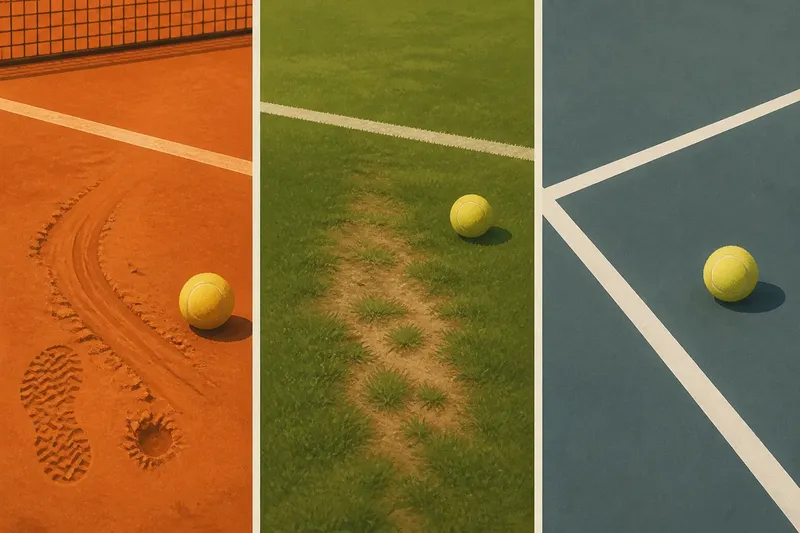
A fresh scuff on grass, a sliding mark on clay and an even painted finish on a hard court point to different materials and upkeep. To tell what makes a tennis court clay, grass or hard, look first at how the surface is built and maintained, then at the traces players leave on it.
Surface names describe broad types, not identical recipes. A clay court needs its loose top layer managed; grass is living turf that wears; a hard court is a rigid base with a coated playing layer. Those construction differences explain why upkeep, appearance and footing vary from venue to venue.
Clay is a layered court that needs regular care
A clay court has a compacted base covered by a loose mineral layer, often brick dust or another crushed material. The granular covering is visible, and maintenance keeps it distributed and settled. Court staff may brush the surface and apply water; the exact routine depends on the venue and conditions.
That loose layer leaves clear traces. Players can slide across it, and their movement may mark the surface. The marks are not merely decoration: they show where a player has moved and can also make a ball’s landing easier to judge. A line call may leave a distinct mark for an umpire to inspect, subject to the court’s procedures.
For someone learning to play, clay’s surface changes how a stop feels. A trained player may allow a foot to travel while slowing down instead of planting abruptly. A beginner should not imitate a slide without instruction; ask a coach about suitable movement and check the venue’s footwear and court-use rules.
Grass is living turf shaped by wear and care
Grass courts are grown and maintained as a playing surface. Their condition depends on the turf and its upkeep, and repeated play wears particular areas, especially around the baseline and service boxes. A worn patch can look different from the surrounding grass, so the court may not have the same appearance from end to end.
The surface also needs attention as a living material. Staff manage the grass and prepare the court so players have a usable, even area. Weather and wear can affect the footing, which is why players adjust their steps rather than assuming every part of the court will feel identical.
For a spectator, the scuffs and worn zones provide clues to where play has concentrated. For a player, they are a reminder to follow venue guidance and take care when footing feels uncertain. The condition of a particular court matters more than the word “grass” on its own.
Hard courts have a rigid base and a coated finish
A hard court is built on a rigid base with a coated playing layer. The coating can vary in colour and texture, and courts of this type are not all made or maintained in precisely the same way. Their surface tends to look continuous rather than granular or grassy, with painted lines marking the playing area.
That construction usually offers a more uniform platform underfoot than loose clay or living turf, but the finish and condition still matter. A hard court can show wear, and its playing character depends on its particular surface and preparation. Treating every hard court as interchangeable overlooks those differences.
For everyday use, inspect the court for visible damage or debris and follow the venue’s instructions about footwear. If the surface looks damaged or unsafe, ask staff before playing rather than guessing whether it is suitable.
What visible clues identify each tennis court surface?
What does a clay court look like?
Clay usually has a granular, often reddish or ochre-coloured top layer, though the material and colour can vary. Sliding marks and ball marks may remain visible until the surface is brushed or otherwise maintained.
How can you recognise a grass court?
Look for living turf and areas of wear where players move and serve repeatedly. The contrast between fresh grass and worn patches can make the playing surface look less uniform than a coated hard court.
What distinguishes a hard court?
A hard court has a rigid base covered by a painted or coated layer, commonly with a continuous, firm-looking finish. Its colour and texture vary, so construction and appearance together are more useful clues than colour alone.
Why do tennis courts need different maintenance?
Clay has a loose covering that needs care to keep it distributed, grass is living turf that grows and wears, and hard courts have a coated layer that can require upkeep. The work differs because the materials and the ways they change through use are different.
Use a short inspection to identify the surface
Before play or while watching, check visible material and signs of upkeep rather than relying on a venue label. Each observation leads to a practical next decision:
- Check for loose granular material. If it is present, treat the court as likely clay and follow any instructions about brushing or sliding; if not, look for turf or a coated finish instead.
- Check for living grass. If the playing area is turf, look for worn patches and take care around them; if it is not turf, compare the surface with clay or a hard-court coating.
- Check whether the finish is continuous and coated. If it is, a hard court is the likely type; if the surface is granular or grassy, identify that material before choosing footwear.
- Check for fresh scuffs or sliding marks. If they lie on loose material, they support a clay identification; if they appear among worn turf, read them as signs of grass wear; if neither fits, inspect the construction more closely.
- Check whether the court looks worn or uneven. If it does, ask venue staff whether it is ready for play; if it looks maintained, still follow posted instructions rather than assuming all areas are alike.
- Check footwear guidance at the venue. If a specific shoe type is required, use it; if the guidance is unclear, ask staff before entering the court.
Imagine you arrive at a local court whose booking page only says “outdoor court”. You see a continuous green coating, no visible grass blades and no loose mineral layer; you check the entrance notice and find that it asks players to use court shoes. The observations point to a hard court, so you use the specified shoes. If the coating had been damaged or the surface had debris on it, the safer decision would be to ask staff before playing.
Surface construction answers common questions
Is every clay court made from brick dust?
No. Brick dust is common, but clay courts can use other crushed mineral materials. The useful identifying feature is the loose granular top layer, not a single required colour or ingredient.
Does a grass court need more than mowing?
Grass requires care as a living playing surface, including attention to growth, wear and preparation. The precise maintenance varies by venue, so follow local instructions rather than assuming every grass court is managed in the same way.
Are all hard courts the same?
No. The base, coating, finish and condition can differ. A continuous coated surface is a useful clue to the court type, but it does not tell you everything about its upkeep or playing character.
Read the materials before relying on the label
Clay, grass and hard courts are easiest to distinguish by their construction and the maintenance each material needs. Granules, living turf and a coated rigid surface leave different visible clues, while wear shows where those materials have been used. When a court’s condition or footwear rules are unclear, ask the venue; the material offers a starting point, not a substitute for local guidance.