Crosscourt or Down the Line? Reading the Space in a Rally
Crosscourt or down the line? Learn how the ball’s height, your balance and the opponent’s contact point shape a reliable choice in the rally.
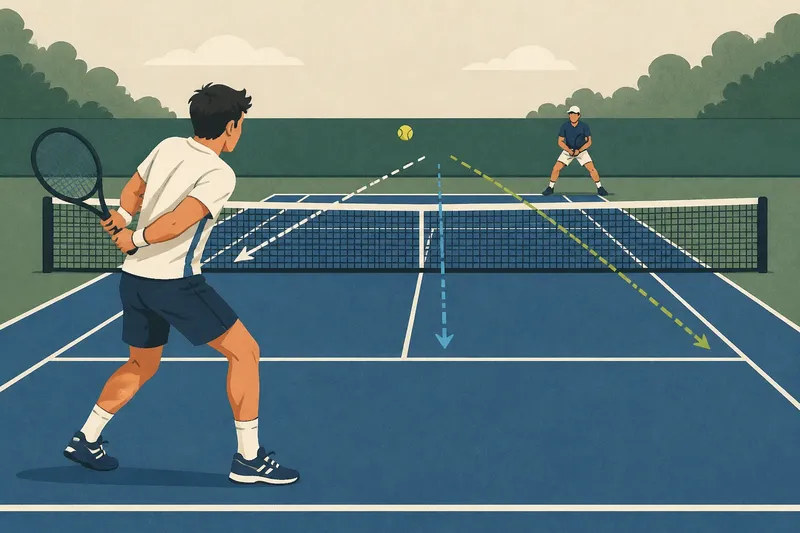
Crosscourt or down the line is a decision about the ball you can actually strike, not an invitation to aim at an empty patch of court. From a stretched position, a deep ball through the middle may be more useful than either sharp angle; from a balanced stance, a change of direction can make the opponent adjust their feet and stroke.
To read the choice, watch the incoming ball’s height and pace, your own contact point, and the opponent’s preparation. Those details tell you whether you can control the racket face and whether a change of direction is likely to be clean or merely ambitious.
Crosscourt suits a ball you can guide with margin
A crosscourt shot travels over the lower middle of the net and has a longer diagonal path than a shot down the line. That extra room can help when you want to send a steady rally ball deep without aiming close to a sideline. It is a useful direction to practise when the incoming ball arrives at a comfortable height and you can meet it in front of your body.
The quality of contact matters more than the label. If the ball is dropping beside you or your feet are still moving, trying to whip it sharply crosscourt can send it beyond the singles sideline. A higher, deeper ball with less angle may keep you in the exchange and allow time to set your feet for the next stroke.
Notice the ball’s bounce as well. A high ball that rises towards shoulder height may be difficult to steer sharply, even if the open court looks inviting. A lower ball can offer a different challenge: you may need to bend your knees and make a compact swing rather than reaching down with a stiff arm.
Down the line asks for a clean change of direction
A down-the-line shot crosses the net nearer a post and has less court length in which to land. It is demanding when you are late, because there is less margin for a ball that floats long or drifts beyond the sideline. It becomes more manageable when your feet are set, the ball is in front, and you can finish the swing without falling sideways.
It can also be a useful way to alter a familiar rally pattern. If you have been hitting crosscourt and receive a ball that sits up within reach, redirecting it down the line can make the opponent move and change their next contact. The shot need not be a winner: a controlled change that lands safely can be enough to make the exchange less predictable.
Do not confuse a visible gap with a playable target. A ball arriving fast at your body may leave little time to turn your shoulders, even if the line looks vacant. In that moment, the sound choice may be to block the ball back through the centre rather than force a direction your contact does not support.
Contact point and footwork shape the decision
Before choosing a target, check whether you can meet the ball in front and stay balanced through contact. If your weight is carrying you backwards, a sudden change of direction often demands more from your hand and timing. If you have arrived early and can set your stance, you have more room to direct the racket face deliberately.
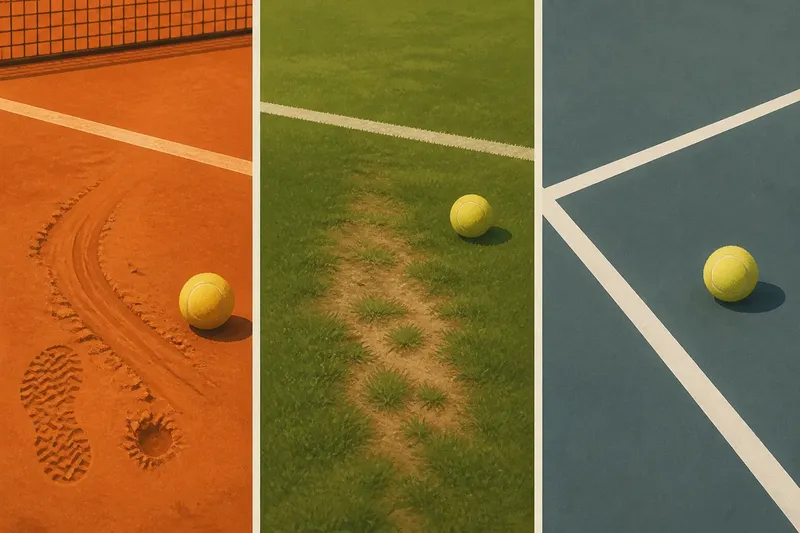
Footwork is part of the shot, not a separate task that begins afterwards. Small adjustment steps help you create space from the ball; a final step towards the contact point can steady the swing. On a clay court, where the bounce may sit up differently from a hard court, allow time to adjust rather than assuming the ball will meet your racket at the same height each time.
Say you are on a hard court, and an invented rally sends a deep ball towards your backhand. You arrive late, with the ball beside your hip and your weight moving backwards. You take a compact swing and send it high through the middle; the expected result is a safer, deeper reply, though it gives up the chance to redirect sharply. If, on the next suitable ball, you arrive early and meet it in front, you can try a measured down-the-line change, accepting the tighter target in return for a different rally pattern.
How do ball height and contact affect your choice?
What if the ball is above shoulder height?
A high contact can make a sharp angle awkward, especially if you have to reach rather than set your feet. Use a controlled swing and a larger target unless you are balanced and comfortable striking at that height.
When should I change direction down the line?
Try it when you can meet the ball in front and keep your balance through the swing. If the ball is behind you or your feet are still moving, a deeper crosscourt or central reply is usually easier to control.
Does the court surface change the decision?
Surface affects how the ball bounces and how much time you have to prepare. On clay, allow for a higher or slower bounce; on a faster court, be ready for a shorter preparation window and favour a compact swing when rushed.
Use a short routine before changing direction
In a rally, there is little time for a long calculation. Use a quick sequence: judge your balance, locate the ball relative to your body, then choose a target your swing can support. The routine is useful because it starts with your contact rather than the opponent’s apparent position.
- If your feet are set and the ball is in front, choose a controlled crosscourt or line target; if the ball is behind you, send it deeper through the middle instead.
- If the ball is rising above shoulder height, use a higher, safer trajectory; if it is at a comfortable height, consider a firmer directional shot.
- If you are moving backwards, shorten the swing and aim away from the sidelines; if you can step into the ball, use a more deliberate change of direction.
- If the incoming ball is fast at your body, block it towards a broad central target; if you have time to turn, choose a side with a controlled swing.
- If the bounce gives you extra time, adjust your feet before selecting a sharper angle; if it stays low or arrives quickly, keep the target conservative.
- If the opponent’s position invites a change but your contact is unstable, prioritise a safe reply; if your balance and timing are sound, use the opening with a target that leaves room inside the lines.
In practice, imagine a partner feeding balls to your backhand on a hard court. Your starting position is just behind the baseline, and the invented feed alternates between a deep ball at shoulder height and a shorter ball at waist height. On the deep feed, you take a compact swing through the middle; the expected result is a high, deep reply that buys time but does not redirect the rally. On the shorter feed, you move forward, set your feet and send a controlled ball down the line; the expected trade-off is a more varied rally at the cost of a narrower target. The decision changes with the contact you can make, not simply with the space you can see.
Read the stroke before the ball leaves the racket
When watching a match, look at the player’s feet and racket preparation as the ball approaches. A player who has time to set their stance and meet the ball in front can usually choose a direction more deliberately. Someone reaching late may have to send the ball back with height or use the middle, even when a sideline appears open.
That observation also makes the next shot easier to understand. A change of direction often begins with a comfortable contact, while a rushed stroke tends to favour a safer route. Keep your attention on the quality of contact and the player’s balance: those clues explain why the ball went where it did, and what kind of reply the stroke was likely to invite.