The Tie-Break Is Not Just a Short Set
Follow the tennis tie-break’s serving order, end changes and changing stakes with a simple viewing checklist, so each point is easier to read.
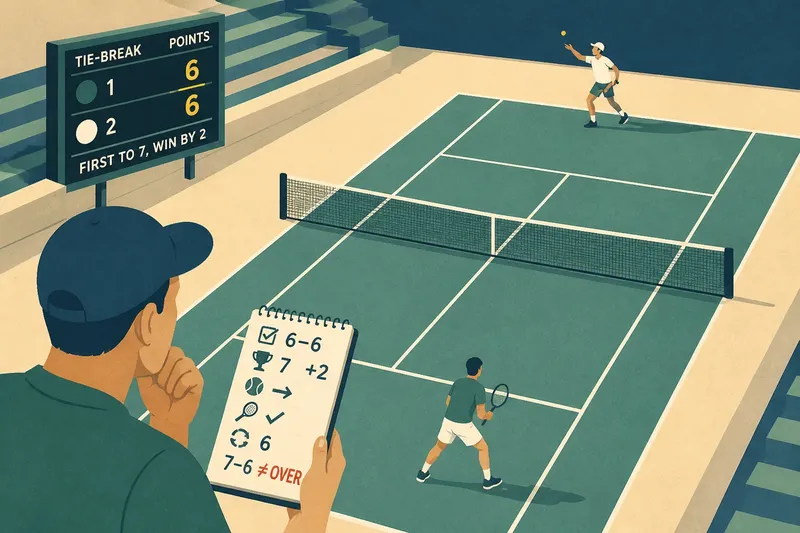
A tennis tie-break is easiest to follow when you track who serves next and what the score permits, rather than treating it as a miniature set. The tennis tie-break changes the service pattern and the route to winning, while the set itself remains unresolved until the required target and margin are reached.
The set reaches a boundary before the tie-break begins
In many formats, a set reaches a tie-break at six games all. The competition rules determine whether one is played then and which format applies; not every event uses the same procedure, particularly in a deciding set.
Before the tie-break, players take turns serving whole games. In the tie-break, service changes after the opening point and then in two-point turns. That altered sequence is one of the most useful things to watch: it tells you who will serve the next point and whether the player serving has the usual service advantage.
The winning target includes a two-point margin
In the familiar first-to-seven format, points are called as zero, one, two and so on. A player must reach at least seven and lead by two. At six-all, the next point cannot end the tie-break; at seven-six, the leader still needs another point without conceding one.
Other formats may set a different target, including a deciding tie-break in place of a full final set. Check the event rules or listen to the umpire’s announcement rather than assuming that every tie-break ends at the same score.
The service order shapes each short stretch
The player due to serve first opens with one point from the deuce court. The opponent then serves two points, starting from the ad court; after that, the players alternate in two-point blocks. If you lose track, note the last server and the number of points played since their turn began.
A point won against the server is often called a mini-break. The term describes a shift in the expected service pattern; it does not create a separate rule or score. It can matter because a player who wins a return point may put the opponent under pressure before their own next service turn.
Say the score is 4–3 and the player who opened the tie-break is serving. If that player loses the point, the score becomes 4–4 and the other player is due to serve the next two. The score is level, but the next service stretch now belongs to the opponent.
End changes mark the tie-break without resetting it
Under the usual procedure, players change ends after every six points. The change might fall at 3–3 or 6–6, depending on the score and how the tie-break has unfolded. The score and service sequence continue; neither starts over.
Use the pause to orient yourself: note the score, who served most recently and who is next. Sun, wind or a different view from the other end may be relevant context, but none alone explains why a point was won or lost.
A viewing checklist makes the sequence easier to follow
Keep this short checklist in view as the points unfold. Each observation leads to a specific next action, so you can recover your place even if the broadcast graphic changes.
- Check whether the set has reached the event’s tie-break boundary; if it has, expect tie-break scoring, and if it has not, keep following ordinary game scoring.
- Check the announced target and margin; if the format requires seven points and a two-point lead, continue watching after six-all, and if the event specifies another format, use that rule instead.
- Check who served the opening point; if that player served only once, expect the opponent to serve the next two, and if you missed the opening, use the umpire’s call or scoreboard to re-establish the order.
- Check whether the current point is on the server’s turn or the receiver’s turn; if the receiver wins it, note a mini-break, and if the server wins it, keep the service order unchanged.
- Check the total number of points at an end change; if six points have been played since the previous change, expect the players to switch ends, and if the change has not yet fallen due, keep tracking the current service turn.
- Check the score after each point against the required margin; if one player has reached the target but leads by only one, continue watching, and if the player leads by two, the tie-break is complete.
Why do viewers ask about tie-break rules?
Why does the first server serve only one point?
The opening server takes one point, then the opponent serves two; the players subsequently alternate in two-point blocks. This is the tie-break’s service procedure, rather than a continuation of the previous game’s rotation.
Does every tie-break end at seven?
No. In a common format, seven is the minimum target and the winner must lead by two, so play continues if the score is six-all or if the players remain within one point after reaching seven. The competition rules determine whether a different target applies.
What does a mini-break mean?
It is an informal name for a point won against the opponent’s serve during a tie-break. It signals a shift in the service pattern, not a separate score or rule.
When do players change ends?
Under the usual procedure, they change ends after every six points. The score and service order carry on through the change.
Keep the set’s outcome separate from the live sequence
During play, the tie-break score tells you the current point contest; the set score records the larger result. A completed set shown as 7–6 means the players were level at six games each before the tie-break decided it. Some scoreboards show the tie-break points in brackets, while others use a different display.
Imagine you tune in at six games all and the event has announced a first-to-seven tie-break with a two-point margin. You see the tie-break at 6–6, with the second player due to serve. You note that the next point cannot finish the contest by itself; the second player serves, loses the point, and the score becomes 7–6. The first player is now one point from the set, but the two-point margin is not yet met, so you keep watching. If the first player wins the next point, the score reaches 8–6 and the set ends; if the second player wins, it returns to 7–7 and the tie-break continues. The same sequence tells you the score, the next consequence and the remaining route for either player.
For a tennis tie-break, the useful viewing habit is to name the next server, check whether the point is on serve, and compare the score with the target and margin. That keeps attention on the tie-break’s distinct rhythm without confusing a momentary lead with a finished set.