The Score Before the Point: Why Tennis Uses Love, 15, 30 and 40
Tennis scoring, from love to 40, becomes easier to follow when you know how points build games, games build sets and the score changes at deuce.
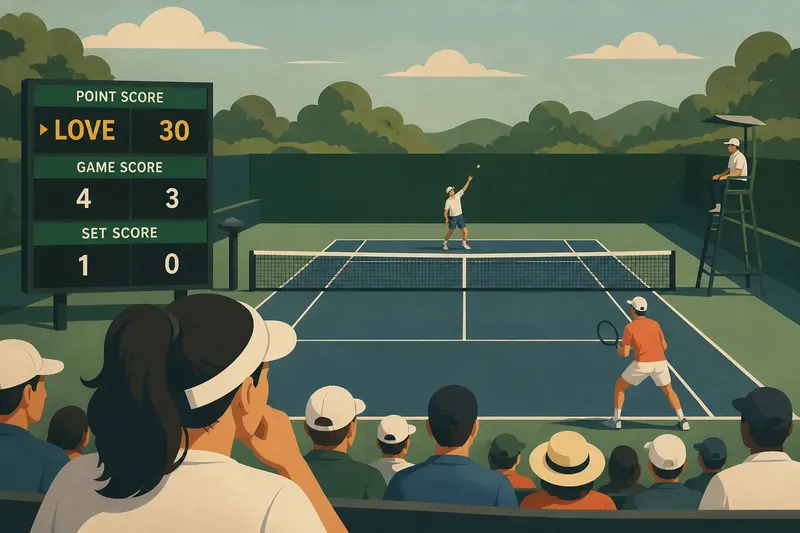
Tennis scoring from love to 40 is easiest to follow when you treat each call as part of one game, not as a count of the whole match. The umpire’s call tells you who is close to taking that game; completed games then build the set score.
The numbers can sound arbitrary, particularly when the call moves from 30 to 40 rather than to 45. They still provide a useful map. Keep points, games and sets separate, and a crowded scoreboard becomes a sequence of clear questions: who leads this point, who leads this game, and who is nearer to the set?
Follow each game from love to 40
At the start of a game, both players are on love. A point won moves that player’s score to 15; a second point takes it to 30, and a third to 40. The opponent’s score is called alongside it, so 30–15 means the server has won two points and the receiver one.
After 40, the game is not always over. If a player on 40 wins the next point while the opponent is below 40, that player wins the game. If both players reach 40, the score is deuce in the standard advantage format. From there, a player must win two points in succession: one to gain advantage and another to take the game.
Some competitions use no-ad scoring. In that format, when the score reaches deuce, the next point decides the game; there is no advantage point followed by a further chance. The event’s rules determine which format applies, so a viewer should not assume that every game continues beyond deuce.
“Love” means no points in the current game. It does not mean that a player has lost a game or a set. A player can be at love in a fresh game while leading the set comfortably.
At deuce, listen for advantage or a deciding point
In an advantage game, deuce is a tie at 40–40. The player who wins the next point gains advantage; winning the following point takes the game. If that player loses the point instead, the score returns to deuce.
The umpire’s call identifies who has the advantage. If the server wins the point after deuce, the call is “advantage server”; if the receiver wins it, the call is “advantage receiver”. Some scoreboards shorten these labels, but the situation is the same: one player is a point from the game, yet must still win that point.
Imagine you tune in during an advantage-format game at deuce. The receiver wins the next rally, so the call becomes advantage receiver. If the server wins the following rally, the score returns to deuce rather than ending the game. In a no-ad game, by contrast, that first point after deuce would have decided the game.
Keep points, games and sets on separate lines
Tennis has nested scores. Points make up a game, games make up a set, and sets make up a match. A scoreboard may show all of them at once; read each row as a different layer rather than combining the figures.
- Point score: love, 15, 30, 40, deuce or advantage within the game being played.
- Game score: the number of completed games each player has won in the current set.
- Set score: the number of completed sets each player has won in the match.
For instance, a display showing 30–15 alongside a game score of 4–3 does not mean one player has 30 games. The first pair belongs to the current game; the second belongs to the set. When the current game ends, its point score resets for the next game, while the set’s game count changes by one for the winner.
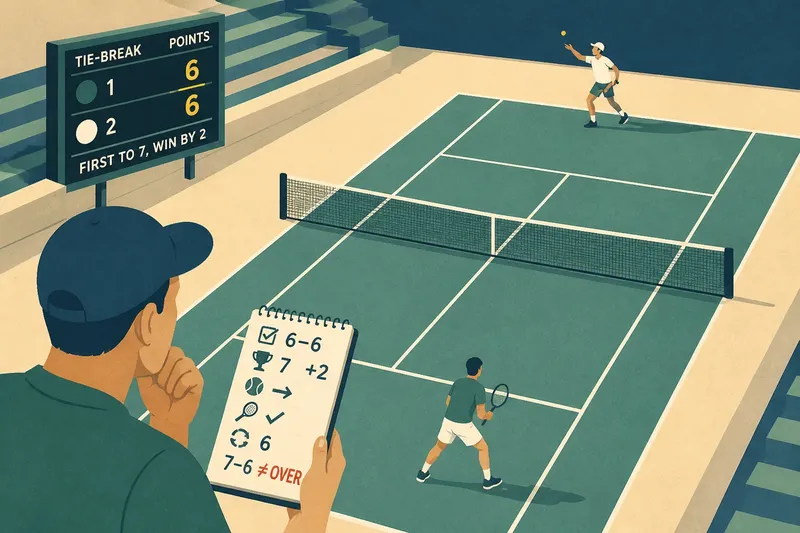
In many standard formats, a player wins a set by reaching six games with a lead of two. If the score reaches six games each, a tie-break is commonly used, though the event’s format can differ. A match is decided by winning the required number of sets, as set out in the competition rules.
Use the umpire’s call to identify the server’s score
The chair umpire calls the server’s score first, followed by the receiver’s. If the server has won one point and the receiver none, the call is 15–love. If the receiver has won two and the server one, it is love–30. This convention lets listeners identify whose score is being called first.
On television, the scoreboard may place the server’s name or a small service indicator beside the player currently serving. At courtside, the umpire’s call provides the same cue. If you lose track after looking away, wait for the next call, note the server, then follow the next rally rather than reconstructing every point already played.
What do common tennis scoring calls mean?
Why does tennis say love instead of zero?
Love is the traditional call for a score of zero in the current game. It means that the player has not won a point in that game, not that they are necessarily behind in the set.
Why does the score go from 30 to 40?
The familiar sequence skips a spoken 45 and moves from 30 to 40. You do not need to convert the calls into ordinary arithmetic; remember their order and that 40 brings the game to its decisive stage.
What does deuce mean in tennis?
Deuce means both players have reached 40 in an advantage-format game. The next point gives one player advantage, and that player must win another point to finish the game; in no-ad scoring, the point after deuce decides it.
Does every tennis set use a tie-break?
No. Tie-break rules depend on the competition and match format, and some sets are decided differently. Check the event’s stated format if the score reaches a situation where the usual pattern no longer seems to apply.
Read the score layer that is changing
During a rally, the point score is the most immediate layer: it tells you whether the point can end the game or bring the players closer to deuce. Once the game ends, shift attention to the set’s game count. When a set ends, look to the match’s set count. This change of focus helps prevent a point call from being mistaken for the larger score.
Say you tune in to an advantage-format game with the server at 40 and the receiver at love, while the set score is 4–3. If the server wins the next rally, the game ends and the set score becomes 5–3; if the receiver wins, the point score becomes 40–15 and the game continues. The set row stays unchanged until the game is decided. If the same situation were a no-ad game at deuce, the next point—not an advantage-and-follow-up sequence—would decide the game.
Tennis scoring from love to 40 uses calls to mark stages rather than count points in a straight spoken line. Keep each score layer separate, and check whether the match uses advantage or no-ad scoring when deuce arrives; that small distinction tells you what the next point can decide.