Watching a Doubles Match: Follow the Net Player
Follow the net player in doubles to see how court position reshapes open space, clarifies a partner’s choices and makes each point easier to read.
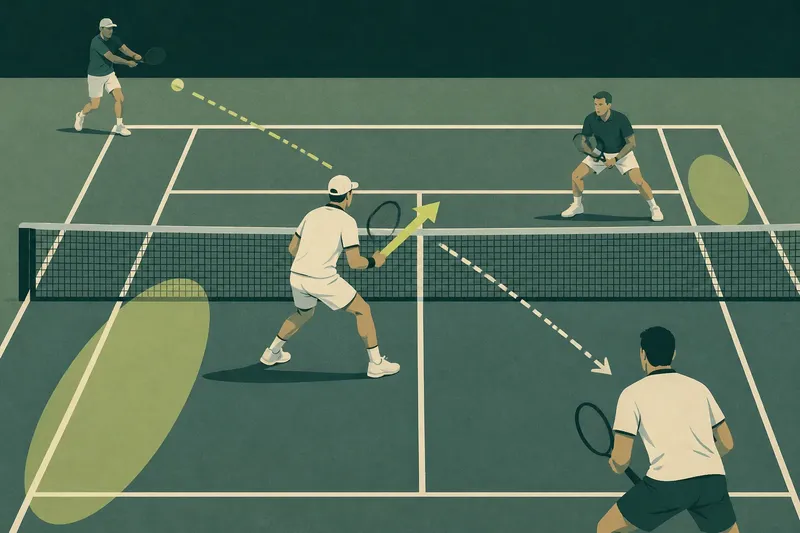
In a doubles match, the net player can make a familiar rally look different simply by moving a step towards the middle. To follow the net player is to watch the open spaces change before anyone hits into them. That makes a useful viewing exercise: trace the player’s position and its effect on both opponents, without trying to call who will win the point.
Imagine a hypothetical point beginning with a serve to the receiver’s backhand. The server’s partner is at the net, the receiver’s partner is opposite, and the receiver returns crosscourt. We can follow that single point from its first return to its result, pausing at each change in position to see what the players’ choices reveal.
Start by finding both players at the net
Before the serve, locate the server’s partner and the receiver’s partner. The server’s partner is often called the net player, though both teams may have a player near the net as the point develops. For this exercise, keep your attention on the server’s partner: notice how close they stand to the net, how far they are from the centre line, and whether their body faces the receiver or the sideline.
There is no single correct starting spot. A player may stand close enough to threaten a volley, or farther back to give more room to react to a return. Their position also depends on the serve and the team’s plan. You do not need to know that plan. Simply register where the player begins, then watch for movement as the ball crosses the net.
In our invented point, the server’s partner starts near the middle of the service box, slightly towards the centre line. The receiver’s partner is also near the net, but shades towards the alley. Those positions leave visible spaces: a wider channel on the server’s side and a gap nearer the receiver’s sideline. These are not promises of where the next shot will go. They are the options the arrangement makes easier to see.
Watch the return change the picture
The serve goes to the receiver’s backhand, and the receiver sends the ball crosscourt. The server’s partner does not chase the return. Instead, they shift towards the middle, keeping their racket in front and their shoulders turned towards the ball. The open space down the line has grown, while the crosscourt route is now more crowded by the net player’s reach.
This is the central observation: positioning changes the apparent size of the court. A player does not need to touch the ball to influence where the next shot seems comfortable. A receiver looking crosscourt sees a racket and a body nearer that route; a down-the-line shot may look more available, but it travels closer to the sideline and has less margin.
Keep your eyes on the net player after the return rather than following the ball all the way to the far baseline. Notice whether they hold their ground, shade towards the centre, or move towards the alley. Then look back to the ball. The sequence matters: movement is a response to the developing point, not an isolated gesture.
Notice how the partner’s position affects the choice
The receiver has a choice after the crosscourt return: continue crosscourt, try down the line, or direct the ball at the net player. The server’s partner’s shift towards the middle makes the first route look more congested. The player’s partner, still behind the baseline, may be ready to cover a reply into the open court. Neither player can cover every angle, so their positions divide responsibility.
In this hypothetical situation, the receiver chooses a controlled shot down the line. It passes beyond the net player, but lands short of the sideline. The server’s partner turns and reaches for a volley, redirecting the ball towards the middle. The net player’s earlier position has shaped the exchange even though the receiver chose the route it appeared to leave open.
For a viewer, the point is not to decide that the receiver should have hit somewhere else. A shot that looks open from the stands may be difficult at pace, and the player has to account for the ball’s height, spin and timing. Instead, notice the trade-off: moving in to threaten one lane can invite another, while staying central may offer a better chance to reach several replies.
Follow the next movement, not a predicted winner
After the volley, the receiver’s partner steps towards the centre to cover the likely reply. The server’s partner, having played the ball, recovers towards the middle too. For a moment, both net players occupy central positions. The sidelines look more available, but a shot towards either one must pass a player who can move in both directions.
The receiver now sends a softer ball towards the server’s partner. The net player takes it with a compact volley, and the ball drops near the receiver’s feet. The receiver gets a racket to it but lifts the ball; the opposing team puts away the next volley. That is the result of this invented point, but the viewing exercise does not depend on it. A different reply could have changed the outcome while leaving the same positioning lesson intact.
Try watching the net player’s feet and racket between contacts. A small split step can show readiness to move either way. A step towards the centre can narrow a crosscourt lane; a retreat can give more time to react but reduce the immediate threat of a volley. These clues help explain what a player is prepared to cover, without turning the point into a guessing game about the winner.
Read the open space without treating it as empty
An open lane is not necessarily an easy shot. The player hitting the ball may be stretched, off balance or forced to play above shoulder height. The net player may also be able to cross into a lane that seems uncovered, especially if their partner is positioned to protect the other side. Watch for the pair’s shape as well as the space between them.
In the invented point, the receiver’s down-the-line reply appeared to use the space the net player had left. But the server’s partner could turn and reach it, and the partner behind them was available to cover the middle. The lane was open in a visual sense, not unguarded in a practical one. That distinction prevents a viewer from judging every shot only by where the players happened to be standing when it was struck.
It can also help to follow the net player through the pause between points. If they return to a similar starting position, compare it with the last point. If they stand farther back or shade towards the alley, notice whether the serve’s direction or the opponent’s return pattern has changed. Treat these as observations, not proof of a deliberate adjustment; a brief look at the court can tell you what changed, but not always why.
Questions that make doubles easier to follow?
Where should I look during a doubles point?
Watch the ball at contact, then briefly return your attention to the net player’s position. This lets you connect the shot with the space the player is trying to close or leave available.
Why does the net player move towards the middle?
Moving towards the centre can put the player nearer a common crosscourt route and shorten the distance to a volley. It also leaves more room towards the alley, which the pair may expect the other player to cover.
Is the net player always trying to intercept the ball?
No. Sometimes the player holds position, protects a lane or waits for a shorter reply rather than reaching for the first ball. A movement that looks quiet can still influence where the opponents choose to hit.
How can I follow positioning without guessing the point?
Describe what you see in neutral terms: the player moved towards the centre, the alley opened, or the partner shifted behind them. Leave the question of who will win until the point is over.
Use the exercise across a whole game
For the next game you watch, choose one net player and follow three things: their starting place, their movement after the return, and where they recover after a volley. You can jot down a few words between points, such as “central, shaded across, recovered”. The notes are there to keep your attention on movement, not to rate the player or predict the next shot.
Then compare the two teams. One may keep its net player near the middle, while the other leaves more room towards the alley. Look at what each partner does to compensate. A pair’s positions make more sense together than they do when each player is viewed alone.
Following the net player in doubles turns the court into a sequence of changing options. In the hypothetical point, a shift towards the centre narrowed one route, exposed another and influenced the receiver’s reply, yet the result still depended on the next contact. Watch that movement on its own terms: it gives you a clearer account of the point, whether the ball lands in or out.